

Here are random discoveries (and a few thoughts) since I quit the newspaper six months ago. Posting here to help remember — and because this is searchable.
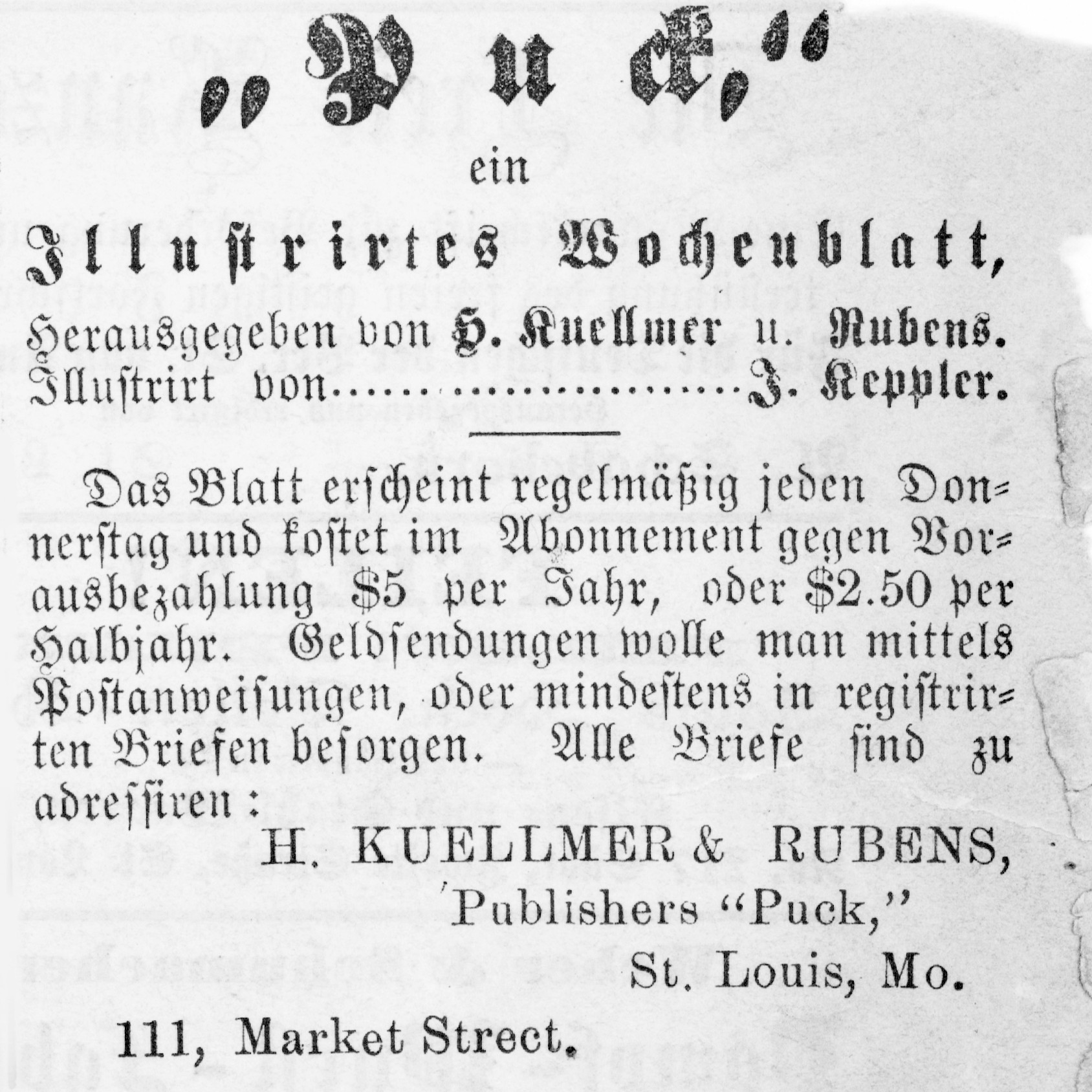
> Austrian cartoonist Joseph Keppler, who emigrated to the United States in 1867, started Puck magazine in St. Louis in 1871. It was first published in German. He moved the publication to New York a few years later.
> George Shoaf, star reporter for the socialist Appeal to Reason, faked his kidnapping (and possible murder) in 1911, apparently when he realized he had bungled his coverage of the trial of John and James McNamara (who were accused of bombing the Los Angeles Times) — and after he ran off with a 17-year-old stenographer. Shoaf’s wife divorced him in 1912 after he resurfaced. The publisher of the Appeal to Reason, J.A. Wayland, killed himself in 1912.
Shoaf was publicly denounced by the father of the young woman, Elsa Unterman (or Untermann). Letters Shoaf wrote to her were obtained by the editor of The Masses, and used to blackmail the Appeal to Reason. Shoaf, now divorced, married Cora Inez Decker, another socialist; Elsa married Floyd Ramp, a socialist in Oregon, in 1914, but they divorced a couple years later. Elsa then married Myron Sprague of Los Angeles in 1924; they also divorced.
George Shoaf’s daughter, Eloise Garfield, retired in 1960. She worked 15 years for the LA Times, the same newspaper the McNamara brothers were accused of bombing.
> Fanny Bagby, a second cousin of E.W. Scripps, likely was the first woman to serve as a top editor of a daily newspaper in St. Louis when she served as managing editor of the Chronicle in the 1880s. She later relocated to San Diego, and is the reason E.W. and his sister, Ellen, ended up there. (Intimate letters she exchanged with another editor and intercepted and publicized by an aggrieved co-worker were a source of embarrassment to her when they worked in Minnesota.) I found her interesting enough for a short piece at rwklose.com.
> A reporter for the St. Louis Globe-Democrat in the 1880s, J.C. Klein, later figured in an incident that nearly triggered a war between the United States and Germany over Samoa. I wrote about him, too.
> A Catholic priest, the Rev. James T. Coffey, was a crusader against gambling and alcohol, and denounced St. Louis political boss Edward Butler in 1902 for operating a telegraph office that was a front for gambling. He, too, has a cameo in a blogpost.
> I finally got around to reading James Neal Primm’s “Lion of the Valley” (among many other books). Some highlights from the 1998 edition:
- The “first task” of the first police force of St. Louis — a four-person constabulary — was to enforce the slave codes. “Their chief duty was to return slaves found on the streets after 9 p.m. to their masters and Indians to an Indian agent” (page 97).
- The Pacific Hotel fire in 1858, which allegedly cost 60 lives, was blamed on “Hawkeye Bill” (page 174). But contemporaneous newspaper accounts identify the suspect as Charles L. Taylor, alias Sanders, or Saunders. And Primm did not provide a source, making it hard to reconcile the apparent discrepancy.
- Regarding politicians who break the law: “Corrupt officials do not thrive in an atmosphere of business integrity” (page 303).
- On why the notorious Pruitt Igoe housing project failed: “Largely responsible for these devastating economics were the rapacious and sloppy construction industry and its unions” (page 453).
> St. Louis-born Meriwether L. Clark Jr. was the founder of Churchill Downs and the Kentucky Derby. He was the grandson of explorer William Clark of Lewis and Clark fame.
> The story of John Berry Meachum’s “floating freedom school” may be more fable than reality. In fact, much of what has been written about Meachum in recent years may be embellished, or just plain wrong. Expecting a deep dive on the subject from writer Peter Downs.
> In 1969, Mr. and Mrs. William Posen sold the small store at 2311 S. 49th Ave., across the street from Cicero Elementary School, to Nick Liosi. Soon after he bought the store, Liosi was robbed. (I collected empty soda bottles on the school’s rooftop and used the deposit money to buy candy bars from Mrs. Posen. A big candy bar cost just 5 cents then.)
> Orrick Johns, son of longtime Post-Dispatch editor George Sibley Johns, says Robert “Fighting Bob” Minor, the radical editorial cartoonist, was mentored during his time in St. Louis by Dr. Leo Kaplan, an ear-and-nose specialist who taught Marxism to Minor (from New Masses, May 1926 edition). Unable to readily find records of a Dr. Kaplan who taught Marxism.
> In 1989, KMOX chief Robert Hyland (1920-1992) was an investor with David Wilhelm’s Forsythe Group in the acquisition of the former St. Louis County Hospital site in Clayton. (Gene McNary and Vince Schoemehl engineered the closing of the city and county’s public hospitals, freeing up choice real estate in the county seat.)
> After many years of zipping right by it, I saw Ambrose Bierce came up with a humorous name for a member of Congress: “Snatchgobble Bilque.” It is in the Devil’s Dictionary, under “Honorable.” (Another fun name is would-be dictator Berzelius “Buzz” Windrip from Upton Sinclair’s “It Can’t Happen Here.” That one I have yet to read.)
> The Scripps family was involved in newspaper work in Britain and the United States. For example, John Locke Scripps, who was born in Cape Girardeau, wrote the first biography of Abraham Lincoln and he was the founder of the Chicago Democratic Press, which was acquired by Chicago Tribune. He served as the Tribune’s chief editor for some time.
> Cyrus the Great issued a decree in BCE 539 that allowed the Hebrews to return to Judah. Trump has been compared to Cyrus by some Xian extremists. There appears to be no consensus on how he died. One account claims his wife killed him.
> David R. Francis and George Knapp, in 1900-1901, offered to buy the Post-Dispatch from Joseph Pulitzer. Surprisingly, Pulitzer agreed to sell it for $1.5 million, then, after one of his executives intervened and just hours before signing the papers, Pulitzer upped the price to $3 million and Francis and Knapp angrily dropped their offer. (see Harper Barnes’ “Standing on a Volcano,” page 114)
> Herbert Slade, nicknamed “the Maori,” may have been the first boxer of color to fight for a heavyweight boxing championship in the United States, back in 1883.
> St. Louis-born Hugh Macomber Ferriss was an acclaimed architectural illustrator in the first half of the 20th century.
> Word Power: pertinacity (quality of being persistent and determined); locofocos (radical Democrats of the 1830s); peculations (wrongful appropriation of public property, funds, or goods for personal use, often by a public official); monomania (preoccupation with one thing); “Quaker guns” (logs painted black to look like cannons); coprolalia (involuntary outbursts of obscene words); marplot (person who ruins or frustrates a plan or project through meddling, often unintentionally); homunculus (very small human or humanoid, used in reference to Stephen Miller); alexithymia (inability to recognize emotions) …
There is a detailed account of the raid on Birmingham led by “Dr. E. Champion” (William Emilius Champion, 1858-1931) at this local broadcaster’s (WCBL Benton/WCCK Calvert City) website (sponsored by the Four Little Pigs Restaurant of Benton): https://www.marshallcountydaily.com/2016/08/08/a-walk-through-history-by-justin-lamb-sponsored-by-four-pigs-restaurant-6/
Henry Kissinger is said to have described Donald Rumsfeld as the “most ruthless” man he knew. (When and in what context one war criminal made that statement about another war criminal is unclear: Maureen Dowd, when she mentioned it in a New York Times column in 2001, credited the information to “one Republican.” Rumsfeld died in 2021 at the age of 88; Kissinger was 100 when he died in 2023.)
> Rose Cecil O’Neill, a pioneering illustrator and suffragette with roots in Branson, Missouri, was the originator of Kewpie dolls.

> Democrats took both the Missouri Senate and Missouri House in the Nov. 2, 1948 election. Democratic control lasted until Jan. 23, 2001, when in a special election the GOP gained a majority in the Senate. Peter Kinder became president pro tem. The November 2002 general election gave GOP control of the House; Catherine Hanaway (now state attorney general) became speaker in January 2003. Bob Holden, a Democrat, had a single term, from 2001-2005. Jay Nixon, also a Democrat, served from 2009 until 2017. That means 2026 is the tenth year that the GOP has controlled the Legislature and the governor’s office. A lost decade, it seems.
> The wife of my godfather, Walter Titzmann, was one of the millions of Germans forced to move after the end of the war. Her 6-year-old son fell, or was pushed, from a truck as they fled — the driver would not stop and the child was lost. Frau Titzmann was from the “Schipine,” the workers section in Breslau (now Wrocław).
> Theda Wilson is the founder of Looking for an Angel, which she created after her 9-year-old son, Christian Taylor Ferguson, went missing in 2003. She also performs as “Thedarox.” She provided the entertainment at a recent health care luncheon at Christian Hospital hosted by state Sen. Angela Mosely.
> Rochelle Walton Gray, a former St. Louis County Council member, is the director of government relations for Red Circle, a nonprofit that is planning to open a “community grocery” at the intersection of 367 and Jennings Road. Red Circle won a $242,500 state appropriation in July 2025 to help fund the effort. Sen. Angela Mosley, Gray’s sister, helped get that appropriation.
> At Florissant ward meeting on Nov. 13, the city said the Quality Inn rooms are getting renovated and the Red Roof Inn will be fixed up and turned into a Baymont. Both properties have new owners. Meanwhile, work on Washington Street will begin soon. Also the city mayor and others are deeply unhappy with the results of the I-270 project — the routing of traffic to Washington, which cut off easy access to Grandview Plaza, and the ugly rocks. Also announced at the Nov. 13 meeting: the St. Louis Hinder Club at the U.S. National Handball Center, 8701 Dunn Road, is buying the vacant Myers House. (Post-Dispatch reported the news on Dec. 1.)
> Deaths that flew under my radar until recently: Amadou Bagayoko of Amadou and Mariam (April 4, 2025); Slovak soprano Patricia Burda Janečková (Oct. 1, 2023). Howard Ramsey, the founder of Noodlers Anonymous and the main star of my RFT story published on Dec. 20, 2000, died in October 2024, just months after Karen, his wife of 57 years. https://bit.ly/3KBbE4E
> Mary Beth Hughes, a B-film, stage and TV actor active from 1939 to 1974, was born in Alton in 1919. She moved away from the St. Louis area when she was a child and died in LA in 1995. Two others from the Metro East: Lee and Lyn Wilde, twin sisters born in 1922 in East St. Louis.
> The GRACE report on Niños de México was released on Nov. 12, 2025. Jacob Barker wrote up the charity’s decision to fold. The story ran Nov. 17, 2025. The allegations of sexual abuse at the U.S.-run Christian orphanages were covered in an in-depth report in 2023 by Post-Dispatch reporter Jesse Bogan. https://www.stltoday.com/news/local/crime-courts/article_186142d4-7299-11ee-9114-87f1a40d7a85.html GRACE is the acronym for Godly Response to Abuse in the Christian Environment.

> Washington University was incorporated on Feb. 22, 1853, as The Eliot Seminary, free of any obligation to pay property taxes. The Missouri Constitution of 1820, which was in effect at the time, imposed no limits on the General Assembly’s able to grant tax exemptions. The state constitution of 1865, however, imposed a limit on the lawmakers’ ability to adopt special laws exempting the property of any named individual or corporation from taxation, but WashU was not affected. Other supposedly exempt institutions were William Jewell, chartered in 1849; Lindenwood, 1853; and Westminster College (Fulton College), 1851.
(The WashU exemption — unusual in that it exempts all university holdings from property taxation, even those for commercial purposes — proved a significant drain on the revenues of the City of St. Louis, especially in the 20th century. Leading businesses in the city, such as International Shoe, donated their properties to the university then leased them back, depriving the city and its schools of revenue. Repeated court challenges, including by the city and the NAACP, failed.)
(P-D reporter Lou Rose, assisted by some WashU undergrads, undertook some reporting on the matter in the late 1970s. I thought the story ran in the Post-Dispatch, but it probably ran in Student Life.)
> One of the oldest still-standing houses in St. Louis County, if not the oldest, is Casa Alvarez, which was built in 1790. Privately owned, it is located at 289 Rue St. Denis in Florissant. (Two French priests founded a small settlement near what is now called the River Des Peres in 1700; they were forced to flee in 1703 because of hostile natives.)
> While searching for the St. Louis edition of the Kansas City Call at Newspapers.com, I found a daily paper called the “Morning Call” that commenced publication in June 1884. (The Jeff City Tribune, in its July 2, 1884 edition, said the Call was “making very poor progress with the work of annihilating the Globe-Democrat.” It said the Call was being financed by Dr. James Henry McLean and “Boss” Filley — presumably Chauncey Filley.) The Call died on July 22, 1884 — or as the Post-Dispatch said, “passed into the Valley of the Shadow of Death.” It cost Dr. McLean about $15,000, the Post-Dispatch said. McLean was a patent medicine man, who made volcanic oil liniment, among other products. The product, “Dr. J.H. McLean’s Volcanic Oil Pain Relieving Liniment,” is still made — and available! Wrote about it at rwklose.com on Nov. 25.
> Rabbi Samuel Schulman is said to have originated the phrase “melting pot,” a claim that was included in obituaries published after his death in 1955. The claim is repeated in “The Life and Works of Rabbi Samuel Schulman” (a 1985 thesis by Lewis Kamrass, now rabbi emeritus of Wise Temple in Cincinnati, in partial fulfillment of the requirements of ordination by the Hebrew Union College-Jewish Institute of Religion in Cincinnati): “Schulman best summarized his own philosophy of America, coining the phrase ‘melting pot’ in a Passover sermon, ‘Shall American Judaism Surrender Its Ideals?’ delivered March 30, 1907. The sermon, and the phrase it contained was published in pamphlet form and appeared in the American Israelite two weeks later [published in the May 9, 1907 edition]. The expression became popularized some two years later in the American version of the play bearing that name by I. [Israel] Zangwill.” But it appears Rabbi Schulman used “melting pot” as early as 1894, in a sermon or address he delivered in 1894 in Kansas City, in which he opposed the so-called “Christian amendment” to the U.S. Constitution. Part of the sermon was republished by the Kansas City Journal on March 11, 1894.
> The town of Chinguetti in Mauritania has multiple family-owned libraries that include 1,000-year-old books. The medieval trading town, a ksar, is endangered. “defund the police” Democrats.
> News reports in late 1900, including in the St. Louis Republic on Dec. 1, said Jim Running Deer of the Choctaw Nation, was executed for the murder three years earlier of his friend, Standing Elk. The two had dueled for the affection of a white woman, Jessie McAdams. Running Deer was sentenced to death but given parole so that he could play baseball with the Carlisle Indian Industrial School team. He promised to return to face sentencing — and did. McAdams’ plea for mercy was ignored; right after Running Deer was shot, she committed suicide. Although the story was reported widely, some accounts with a decidedly racist spin, it is unclear whether any of it was true.
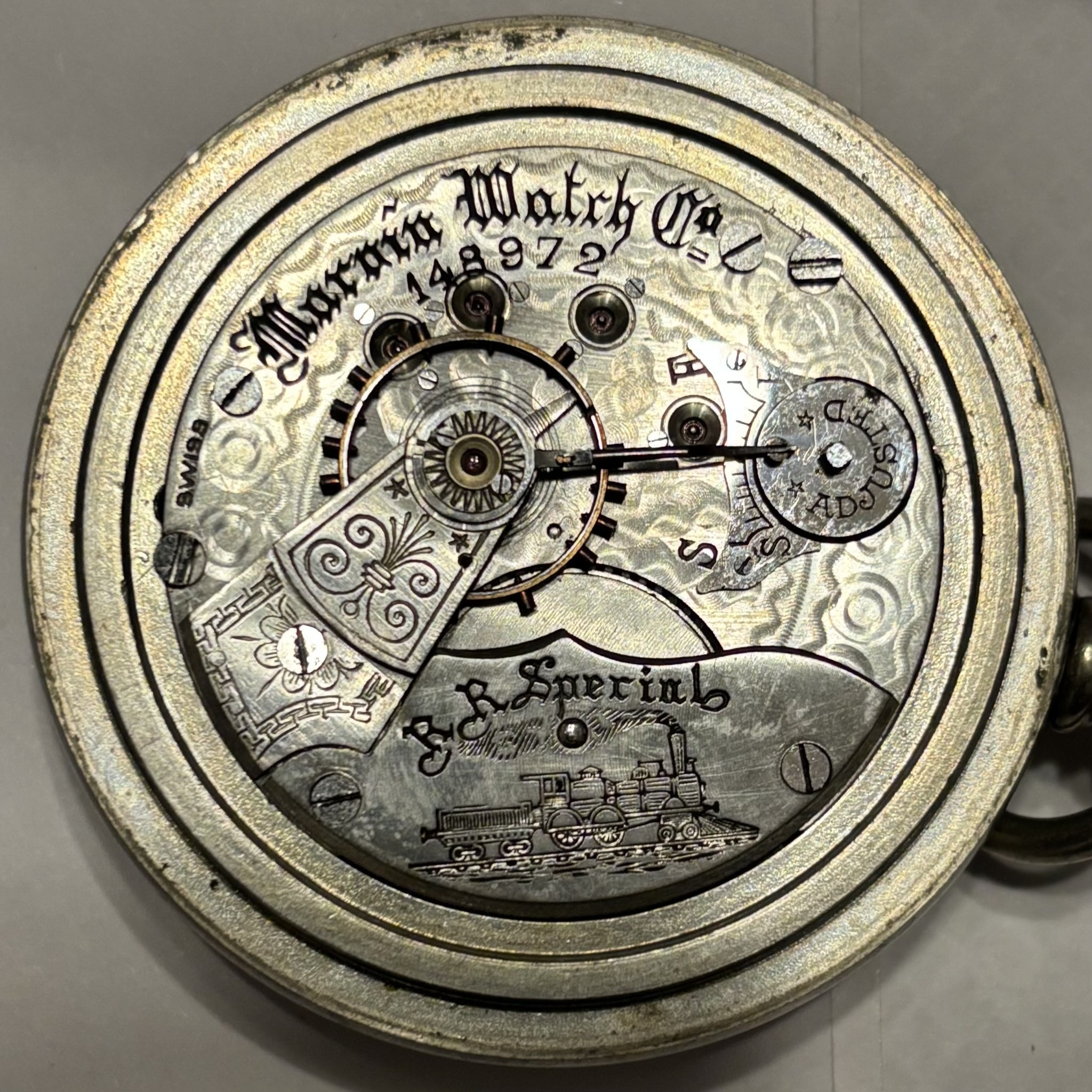
> Checked out the two old pocket watches handed down by family. The “R.R. Special” movement, from my uncle, Richard LaPan (1932-1999), was made by the Swiss Marvin Watch Co. The serial number (148972) is the same as Marvin’s other “18 Size Swiss Imitation American Movements” of the early 1900s, a clear tell that it is a “Swiss fake.” An Elgin watch, from Maureen’s father’s family, appears to have been made in 1904, based on its serial number. Given its age, it could have been Thomas “Red” Kane’s. Red, a notorious member of the Irish Egan’s Rats gang, was her great grandfather.
> Frank D. Sullivan, a longtime city bureaucrat and former P-D reporter, was named co-coordinator of the city’s civil defense efforts by Mayor Joseph Darst. Col. Arthur W. Jacobs, who headed the 307th Military Government Group of the Army Reserves (later named the 307th Civil Affairs Group), was involved.
> Camera relics that I’ve been playing with recently: A Rolleicord (with a Zeiss 4.5 lens) was priced at $65 in 1937 (about $1,500 in 2025). A Nikon F2 Photomic (body-only) was priced at $499 in 1974 (nearly $3,500). The Sony Handycam DCR-TRV950 sold for $2,499.95 ($4,500) in 2002.
> Otto Brandenburger owned a toy and notions business at 515 S. Broadway around the turn of the last century. The business featured a giant painted sign advertisement for “Bente’s St. Louisiana” 5-cent cigars. Brandenburger, born in 1848, was a German immigrant who came with his family to the U.S. in 1858. In about 1902, Otto and his unmarried sister, Wilhemina (1851-1930), moved to Los Angeles, where they lived with older brother, Rudolph (1841-1920). Otto died in 1928. A photo of the business appears in the Missouri Historical Society archives. (Posted picture and notes on social media.)
> Horse racing promoter Robert C. Pate (1838-1914) was known as the gambling king of St. Louis until the early 1880s. He was said to control the local police board. After his conviction in 1882, he and several others identified as members of the corrupt gambling ring of St. Louis, were pardoned by Gov. Thomas T. Crittenden (the same governor who promised Bob Ford a reward and a pardon if he murdered Jesse James). Pate later went to Mexico to open racetracks, but lost much of his fortune. Pate and Crittenden were veterans of the Civil War. Pate was originally from Indiana; Crittenden was a native of Kentucky.
> Looks like animal welfare calls either go to St. Louis County or to the Humane Society. Florissant police will respond to a complaint about a nuisance dog, but the city is not equipped to address an animal welfare issue. That is a shame because the county does not appear to be equipped to handle animal welfare cases anymore because of a lack of funding.

> On Dec. 17, 1950, around the time the U.S. Government was moving Mallinckrodt’s radioactive waste to the airport area in north St. Louis County, the Post-Dispatch republished the National Security Resources Board’s booklet on how to survive an A-bomb blast. It is packed with misinformation; for example, asserting that survivors of Hiroshima and Nagasaki “are not riddled with cancer.” Here’s a link to the report: https://www.orau.org/health-physics-museum/files/library/civil-defense/survival-under-atomic-attack.pdf
> In 1908, William Marion Reedy of the Mirror gave a speech to the Missouri Press Association on “The Myth of the Free Press.” The most complete version I could locate quickly online was published on Nov. 14, 1908, by the Montana Lookout. Here’s an excerpt: “There is a great outcry always against wealth and corruption in the abstract, or a thousand miles away, but when it is brought down to the concrete, at its own door, the average newspaper suddenly draws in its horn, and is found apologizing with more or less speciousness for the institutions and for the system, and for the individuals that rob the community.”

> George Rogers Clark National Historic Park in Vincennes, Indiana, is on the site of Fort Sackville, which he captured in February 1779 after an arduous, 200-mile campaign he led from Kaskaskia. The monument was dedicated in 1936 by FDR. The president said, in part: “Because man did not have our knowledge in these older days, we have wounded nature and nature has taken offense. It is the task of us, the living, to restore to nature many of the riches we have taken from her in order that she may smile once more upon those who come after us. George Rogers Clark did battle against the tomahawk and the rifle. He saved for us the fair land that lay between the mountains and the father of waters. His task is not done. Though we fight with weapons unknown to him, it is still our duty to continue the saving of this fair land.”
> On Dec. 22, 1950, the body of 8-year-old Paul Lee Nicholson was recovered from the river near Caruthersville, Mo. Three local boys — Walter Herrin (or Herron), 11, and his brother, Raymond, 9, and Harvey Neal Journey (or Jurney), 11 — confessed to killing the St. Louis boy. Walter later changed his name to Raymond Stone and was convicted and sentenced to death in the 1974 murder of a Florida farmer’s wife, Jackqueline Smith. His troubled childhood — which was not brought up in his Florida trial — became an issue in his death penalty appeals. Walter, who had spent most of his life in prison, died in 1998.
> The Guardian recently reported on a recent study that suggests raccoons are “beginning to show physical changes that resemble early signs of domestication,” specifically shorter snouts. The study was published Oct. 2, 2025, in Frontiers of Zoology. A link to the study: https://link.springer.com/article/10.1186/s12983-025-00583-1 and a link to story: https://www.theguardian.com/environment/2025/nov/28/raccoons-domesticated-by-us-city-life

> There are lizards at the Climatron. A Missouri Botanical Gardens staffer pointed out a Madagascar giant day gecko that was hanging out on a banana tree when Josh and I visited on Dec. 23.
> In July (of 2025), when I was searching through old editions of the St. Louis Journalism Review for an article, I came across several articles I had written using a pseudonym. “Jay Starling” and “Fred Beaumont” were familiar, but I had forgotten “Hank R. Ring” and “Frank Lee Said.” (The pseudonyms were designed to disguise the fact we had so few actual writers.)
> Monkey mind, or a monkey brain, is what I am accused of having: a restless, agitated, easily distracted brain, one susceptible to the next shiny object, jumping from branch to branch. Marked by inner chaos. I certainly recognize the problem: I have trouble focusing on any one thing for a long period of time. I used to have the discipline to write — or edit — for hours, filtering out all other distractions, but that happens with less frequency. Screens constantly pull me away with the promise of something intriguing. My former job conditioned me to constantly check the wires, my email, social media feeds, various government and news media websites, text messages, and messaging platforms. Making sure we did not miss a story and fail to post a headline became an obsession. It was pointless, just like my obsession with replacing straight (vertical) quotation marks with smart (curly) marks on the newspaper’s website (a problem created by the content management system we used). Typographers and book publishers may appreciate the difference; co-workers and readers could not care less.
(An essay somewhat related to these musings talks about how much of journalism has devolved through the eyes of a veteran nearing the end of his career: “My colleague described contemporary journalism as the information equivalent of fast food. High volume. Easy access. Immediate gratification. Little nourishment.” Here is a link -> https://www.linkedin.com/pulse/web-journalists-real-conversation-veteran-mohammed-imteshal-karim-lsudc/ Another sign of the apocalypse: the top editor of what used to be a major metropolitan newspaper has taken to calling himself a “digital strategist” on LinkedIn.)
Then again, “monkey mind” describes the mental state of much of the United States these days, as people are bombarded with anxiety-inducing assaults on their mental wellbeing from their government, their media, their employers, their culture. The constant chaos, which obscures the rottenness and hollowness of civic life today, pours from their electronic devices — and they are unable to turn away. Not unlike drug addicts, they feel compelled to pay for this constant assault on their brains and health, afraid of the consequences of missing out.

Buddhism offers ways of addressing monkey mind. One Reddit thread offered some tongue-in-cheek suggestions: “make friends with the monkey and give it a job,” “cut the tail of the monkey,” and “drink alcohol regularly and copiously.” Here is a link-> https://www.reddit.com/r/Buddhism/comments/15olvts/is_there_anyway_to_calm_the_monkey_mind_im_really/ But seriously, we all would benefit immensely by changing our habits — stop posting drivel online and limiting our engagement with online distractions.
> Newspaper founder E.W. Scripps had his hand in many things. One I did not realize was his role, with zoologist William Ritter, in launching in 1921 what is today’s Society for Science, designed to bridge the gap between scientists and nonscientists. They believed “a healthy democracy depended on a public understanding of science.”
> There is a joke in here somewhere: The residents of St. Charles County were disturbed about sightings of what was believed to be a black panther and organized several hunts, including on New Year’s Day in 1951. They were unsuccessful, and a week later, confirmed reports said a 300-pound sow, a 500-pound steer and other livestock had been attacked, and in some cases killed, by a small pack of marauding dogs, including one that was black. Still, sightings of the prowling panther continued for months. The Globe-Democrat, in a story published on Jan. 1, 1951, noted the area near the confluence of the Missouri and Mississippi rivers had been troubled by strange and elusive creatures, including Alton’s “Gooseville bear” in 1949 and “a lightly clad Tarzan woman swinging and shouting from the treetops.” Additional details on the wild woman, who likely posed a bigger threat than the panther, were not readily available.
> After a friend suggested a book about local journalism (I assured him the audience would be very small), I came up with a list of interesting characters — reporters, editors, publishers, authors, others — associated with books, magazines and newspapers in St. Louis: Paul Y. Anderson, Fanny Bagby, Garrett Brown, Winston Churchill (not the British PM), Andrew Jackson Davis, John Fahey, Michael Angelo Fanning, Eugene Field, William Gilpin, Fenwich Yellowley Hedley, John W. Jacks, George Sibley Johns, Orrick Johns, Col. Charles Henry Jones, Joseph Keppler, John C. Klein, Jean Knott, Robert Lemen, Dr. James Henry McLean, Robert Minor, Kate Richards O’Hare, Frank O’Hare, Ripley Saunders, Henry M. Tichenor, Harry S. Turner, Stanley Waterloo and Joseph Weydemeyer. Two individuals who crossed my radar but did not have a St. Louis connection: Edith Colby and Frank Griffin.
> My collection of artifacts of vintage tech includes typewriters, pocket watches, cassette and VHS tapes, tape players, a camcorder, a calculator, CDs, dictionaries, film cameras, telephones, newspapers, magazines, and an Encyclopedia Britannica from 1961. Other ephemera: old stamps, pre-euro coins, Soviet currency, QSL cards from defunct shortwave broadcasters (e.g. Radio Tirana, Radio Moscow, Radio Kiev, HCJB, Radio Nederland), postcards. Now deciding whether to declutter or to open a mini museum.
> “Fateful Hours,” a history of the Weimar Republic by Volker Ullrich (2025), highlights Wilhelm Frick, the first Nazi elected to a state ministerial post, and the actions he took that presaged what the regime would do when Hitler took over in 1933. There are eerie similarities to what has unfolded in the past year here too. Also learned more about the Der Stahlhelm and its disreputable candidate in the 1932 presidential election, the antisemite Theodor Duesterberg who was pilloried by the Nazis when it was learned his grandfather was Jewish.
Speaking of Weimar and the rise of the right, the current global influence of Carl Schmitt, the theorist who gave intellectual support to the Nazis, ought to be explored more deeply by the American press. Schmitt justified a strong executive who could determine, unilaterally, a “state of exception” that would allow the suspension of law to restore order. The unitary executive theory, developed post-9/11 and during the George W. Bush administration, draws from Schmitt’s thinking, vesting broad executive power in the presidency. Schmitt and UET both disdain the checks and balances of liberal constitutionalism.

> When presented with extra french fries from the Shish Kebob House, my backyard squirrels buried many of them. I anticipate a crop of french fry plants this spring.
> Revolutionary War hero Richard Clough Anderson Sr. (1750-1826) built and lived at Soldier’s Retreat in Hurstbourne, Ky., near Louisville. The home burned in 1842 (a facsimile was constructed as a private residence in the 1980s). Richard Anderson’s remains are buried in a family plot currently surrounded by suburban sprawl, on the western side of Hurstbourne Lane across from a Barnes & Noble. One of his Louisville-born sons, Robert Anderson (1805-1871), was the commander of Fort Sumter when it was surrendered in April 1861. The younger Anderson, who was promoted to brigadier general, is interred at West Point Cemetery in New York.
> “Good, occasionally poor,” a phrase repeated during BBC’s Shipping Forecast, refers to visibility. “Good” means you can see for about 5 nautical miles; “occasionally poor” means weather can intermittently limit visibility to about 2 nautical miles. Much, it turns out, has been written about Shipping Forecast terminology by people who do not actually care about weather conditions in the seas around the United Kingdom.
> The big coal plant visible south of Interstate 64 near Okawville is the Prairie State Energy Campus.
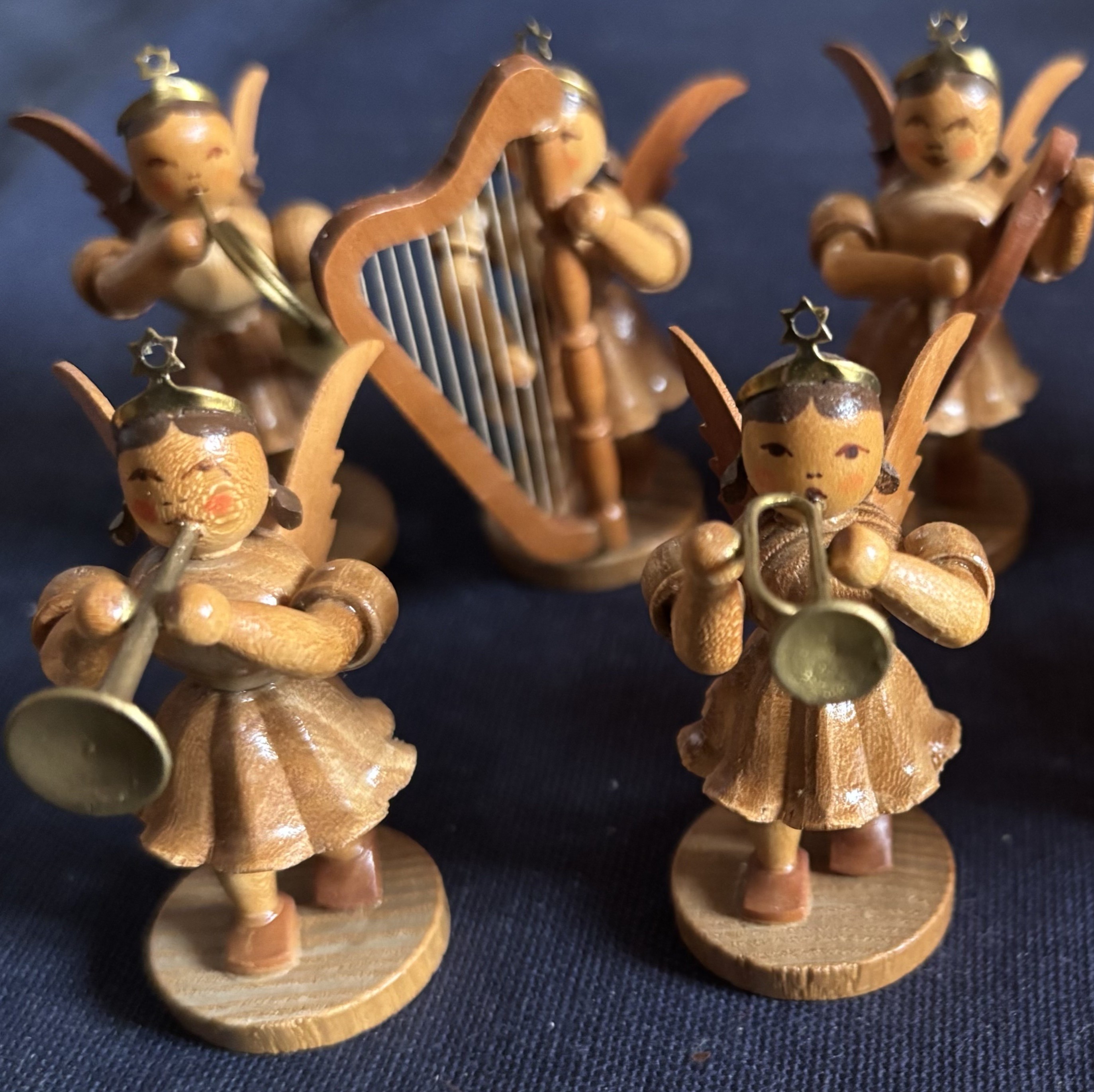
> The Blank Kunsthandwerk in Grünhainichen in the Ergebirge (Ore Mountains) has been making wooden angels in pleated short skirts (Faltenrockengel) and playing musical instruments since 1948. These 6-cm-tall members of an “angel band” are a popular collectible. Ones with an open diadem were made beginning in 1970. Like other collectibles, their value appears to go down with age.
> Marshall County — where TVA created Kentucky Lake — drove out its remaining Black residents in 1908 through a campaign of terror and retaliation. The town of Birmingham, which has been underwater since 1944, was one of the Marshall County communities turned into a “sundown town”; others were Calvert City and Benton. The Kentucky Night Riders forced the Black residents out in Birmingham, seizing their land and property. (White terrorists also targeted Blacks in Golden Pond, in nearby Trigg County.) Today, the population of Marshall County is nearly 95% white; Calvert City, 99%, and Benton, 97.4%. (Not drawing any correlation here, just noting: Trump handily won the county in 2016, 2020 and 2024, taking more than 73% of the vote each time.)
In 1908, the same year that Night Riders drove Black residents out of Marshall County, cigars called “Kentucky Night Riders” — “a little cigar for heavy smokers” — were advertised at three stogies for five cents. Unclear who made them; I found advertisements in a newspaper published in Mansfield, Ohio.
> New York Times columnist Jamelle Bouie (Jan. 11, 2026, print edition) puts Trump’s recklessness in a broader context: “Our history says that we struggle to hold the powerful accountable…. Our history says that with enough power, and if you’re the right kind of American, you can escape consequences altogether and die a citizen in good standing…. If there is a sickness eating away at American democracy, it is our culture of elite impunity.”
I was 6 when Congress gave LBJ broad authority to escalate military involvement in Vietnam; I was 16 when Saigon fell. The war, which played out on television and in popular culture, was the backdrop to my childhood. Like most normal kids (at least back then), I was increasingly repulsed by the violence — the images of carnage, the nightly news body counts, the militarized response to anti-war and civil rights protests. The older I became, the angrier I got. By 1975, much of the nation was tired of talking about Vietnam. Those responsible for the debacle — the lies, the barbarity, the thousands of lives lost — were not held accountable. A narrative took hold: the U.S. lost in Vietnam because of the weak-willed, liberal politicians at home (an American version of the Dolchstoßlegende). The Georgia “peanut farmer,” elected president in 1976, became the poster boy for a paralyzed, indecisive political class. In 1980, the nation elected a reactionary as president who said the U.S. needed to recover from “the Vietnam syndrome of self-hate.” (His administration engaged in a wide range of military adventures, including invading Grenada and fighting proxy wars in Central America.) In 1991, after Operation Desert Storm, his successor declared “the Vietnam syndrome was dead and buried for all time in the sands of the desert.”
Today, the United States is militarily involved in at least five different wars.
This notion of “elite impunity” was underscored more than 20 years ago, when disclosure of detainee abuses at Abu Ghraib led to punishments that focused on lower-level soldiers, but not the people who authorized the abuses. Specialist Charles Graner received the longest sentence, 10 years, but was released in 2011 after just six. He was one of about a dozen soldiers who were criminally charged and convicted. A handful of others who were not criminally charged still faced career consequences. Brigadier General Janis Karpinski, who was in command of detention facilities, was demoted to colonel in 2005 and subsequently retired. In a book published in 2005, Karpinski blamed the abuses on contract employees trained in Afghanistan and Guantánamo Bay and sent to Abu Ghraib by Secretary of Defense Donald Rumsfeld. Karpinski later told an interviewer she had seen a Rumsfeld letter authorizing the use of sensory deprivation and other illegal methods. That authorization stemmed from legal opinions by Bush appointees, including Jay Bybee and John Yoo, that concluded U.S. laws related to torture and other abuses did not apply to interrogators working overseas. (The Office of Professional Responsibility, in 2009, said both Bybee and Yoo committed “professional misconduct” https://bit.ly/3LIhTnU), but its final recommendations were overruled.)

> In case you were wondering, Goethe visited Lower Silesia in 1790, traveling from Breslau (now Wrocław) to Frankenstein (Ząbkowice Śląskie) and Reichenstein (Złoty Stok). His travels took him past areas where chrysoprase was mined, a type of microcrystalline quartz with colors ranging from apple-green to cyan. Friedrich der Große used it at his palace in Potsdam. The Silesian mines, including the Szklary deposit, are mostly exhausted.
> The race to build a commercially viable cotton picker in the first half of the 20th century included at least three efforts in St. Louis, all unsuccessful. John S. Thurman (1868-1939), an early inventor of vacuum cleaners (he gave us “pneumatic carpet renovation” in 1898), tried to build a cotton picker that would vacuum cotton fibers off the bolls. He called his company the Vacuum Cotton Harvester Company. Another company contracted with St. Louis automobile manufacturer Moon Motor Car Company to produce light gasoline-powered machines that used rotary blades and suction in the picker-heads. The American Cotton Picker Corporation, launched by GM founder W.C. Durant (1861-1947), built about 500 of the machines, but had the misfortune of launching at the onset of the Great Depression. Most of the St. Louis-made machines were sold to the Soviet Union, which was interested in mechanized cotton harvesting. (Moon Motor failed in 1930.) In the mid-1930s, Memphis inventor Louis C. Stukenborg (1881-1969) put what he called his “St. Louis Cotton Picker” on the market. The first picker was built in 1936 by the St. Louis Car Company, which made street cars.
> Owen T. Bugg, one of many inventors with patents on a cotton-picking machine, also is credited with the O.T. Bugg Friendly Beacon Electric Candle in 1898. The early portable electrical lights were not designed for continuous operation because the batteries discharged so quickly; they were supposed to be illuminated just for a few seconds, hence the name “flash” lights.

> Fifty years ago, the smallest town in Missouri was Wittenberg, which had a population of eight at the time, mostly from the same family. The Perry County town, on the banks of the Mississippi just north of Tower Rock, was founded in 1839 by German Lutherans, according to a feature published Jan. 18, 1976, by the Post-Dispatch. Wittenberg’s remaining residents successfully petitioned the county to disincorporate the town in 1983; the Great Flood of 1993 destroyed most of what was left. Currently, the U.S. Census identifies the smallest incorporated place in Missouri as the village of Friedenswald, a two-person, 65-acre homestead that overlooks the Lake of the Ozarks in Camden County. Dave and Dana Krehbiel organized the village in 2008 under a short-lived, since-repealed village incorporation law. Friedenswald is one of six incorporated places in Missouri with fewer than a dozen residents, but only two of them have roots in the 19th century. Both Bigelow and Dalton were established in the 1860s as railroad stops. Bigelow had 195 people in 1900; Dalton, 398 in 1920. Both had just six residents in 2024, census records show.
> In 1951, the United States and Denmark concluded a new treaty to provide for the joint defense of Greenland. This came after years of U.S. politicians insisting that we should buy Greenland and even take Iceland, considering it essential for defense. (Canadians similarly floated the idea of adding Greenland to the Dominion.) Denmark, which was still rebuilding after the war, vigorously insisted it would not sell Greenland. So, when the treaty was announced, it was hailed by both sides as the best of all possible results: an acknowledgement of Danish sovereignty but also a concession that the U.S. was now the counterbalance to the Soviet Union and its satellites. Typical was this editorial in the Muskegon Chronicle, published on May 15, 1951: “Denmark is a small nation, only minutes away from Russian planes and a few hours from Russian troops in Eastern Europe. Yet Denmark joins us and risks Russian vengeance. That takes courage of a kind many of us sometimes ignore. And it takes a clear understanding of what the issues are in this struggle against Russian imperialism. Denmark and other nations like her have willingly crawled out on a limb to help make us strong in mutual defense against Russia. Let those who talk of withdrawing from Europe and creating an American Gibraltar remember that. Let them consider that by forgetting Europe we would be abandoning nations which have risked everything to stand with us, for our benefit quite as much as for theirs.”

 Roland Klose