
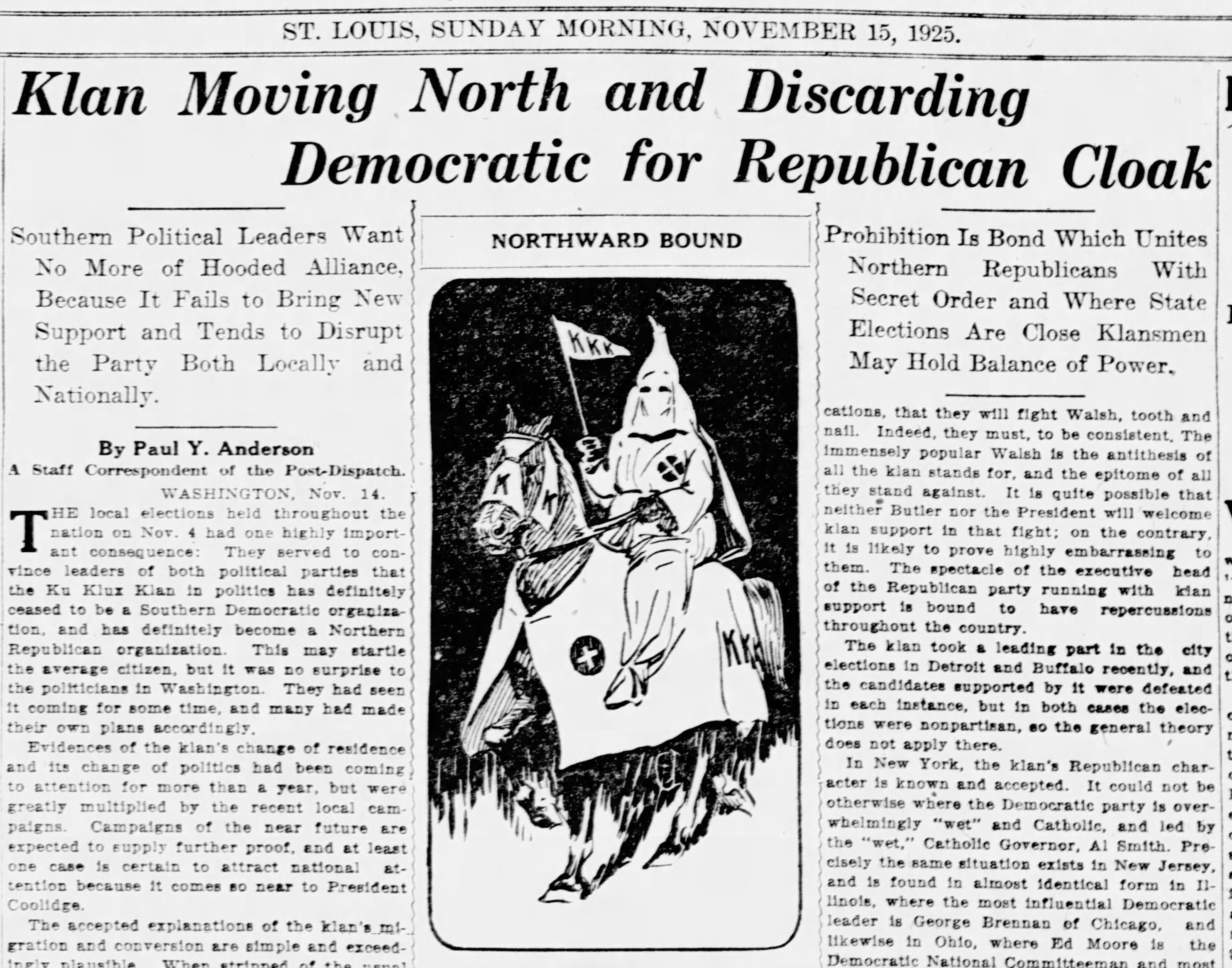
In 1925, Post-Dispatch reporter Paul Y. Anderson took note of the Ku Klux Klan’s apparent shift from the Democratic Party to the Republicans.
The Klan, he wrote, was finding itself increasingly shunned by the South’s entrenched Democratic establishment because its terrorism was fueling the mass exodus of Black workers from the region, undermining white-controlled commerce. (It is not unlike the concerns expressed today by some employers about the targeting of low-wage immigrant workers.)
“Mistreated he doubtless has been, but the negro is indispensable to Southern prosperity, because he performs the bulk of its manual labor, both agricultural and industrial,” Anderson wrote. “For this reason, there has been a widespread and concerted movement among Southern business men for several years to keep the negroes from going North. The klan, tending to defeat this vital effort, was seen as an economic menace.”

Underscoring how unpopular the Klan was in the South, The Commercial Appeal – for many years the voice of Memphis’ establishment – was among southern newspapers to distinguish itself by exposing the Klan’s activities, winning a Pulitzer in 1923, at the same time embracing the segregationist policies of that era.
But the Klan found new allies as it spread north and west. Its racism and its pro-Prohibition, Christian nationalist and anti-immigrant stances resonated with wide swaths of the white population. It scored notable successes – a mayor in Indianapolis and a governor in Kansas, among others – and recruited thousands in St. Louis.
In 1924, the president of the St. Louis Board of Police Commissioners, then a Republican candidate for governor, had to publicly deny allegations that he was a member and supporter of the KKK after a national publication identified him as one. But the shadow of the Klan never completely left Victor J. Miller, who lost the race for governor then won the election for mayor in 1925. On election night, a small cross was burned outside of City Hall, marking his victory, according to reports by the Post-Dispatch and St. Louis Argus. – Roland Klose, Nov. 15, 2025
Here are links to the Anderson story on Newspapers.com: https://www.newspapers.com/article/st-louis-post-dispatch/184995825/ and https://www.newspapers.com/article/st-louis-post-dispatch/184995857/

 Roland Klose